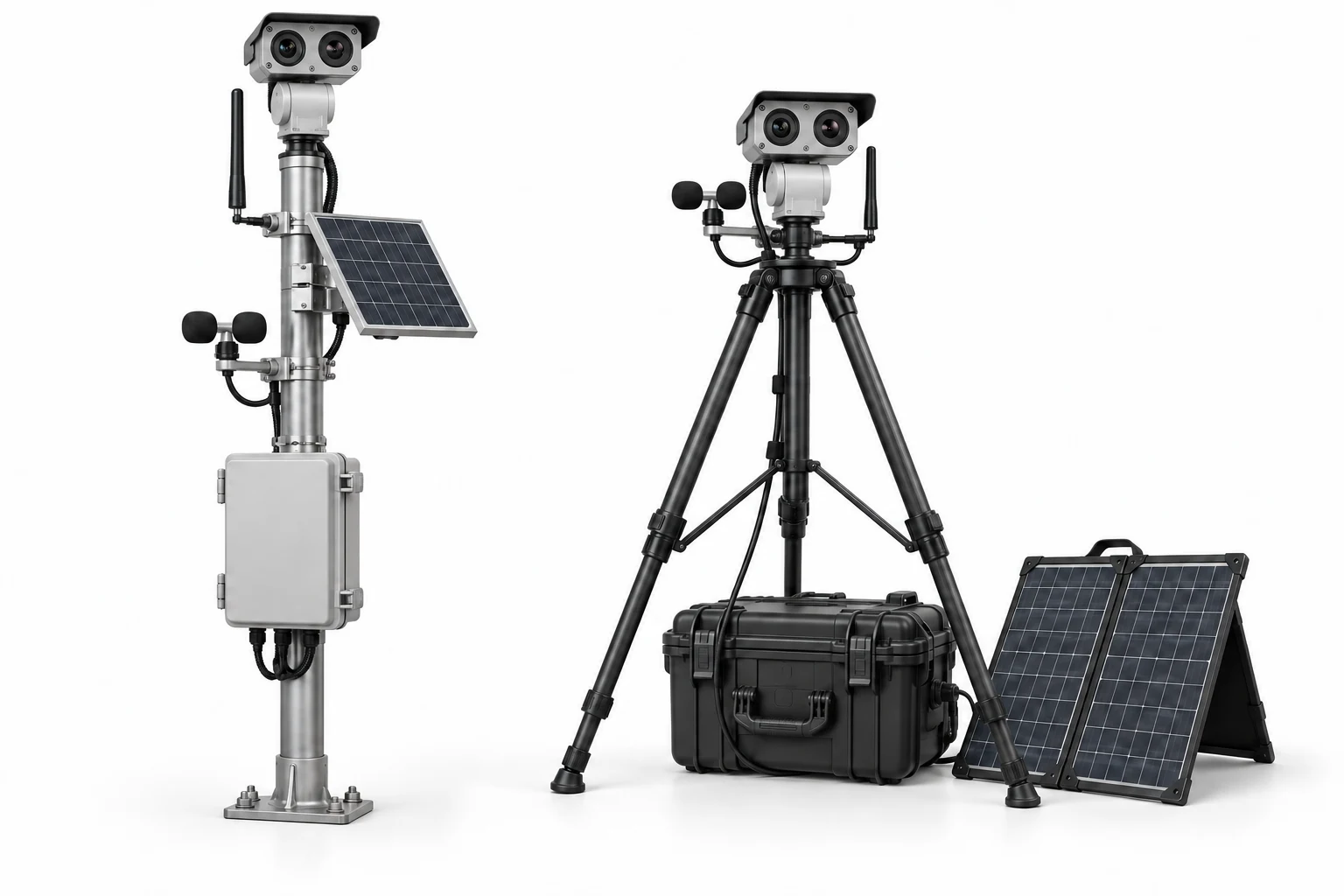
What we are building
Distributed sensing is a proven concept to cover large areas: multiple stations with simple sensors are synchronized and their information combined into a precise picture. Each station is inexpensive enough to deploy in quantity, maintain locally and replace when it fails or is lost.
Drones can be controlled in multiple ways: standard hobbyist radio frequencies (RF), cellular, or via fibre optic. They also make a distinctive noise and have an unmistakable visual signature. Our sensor arrays combine all three sensors: visual, RF, and sound.
Our first PoC focused on the audio component, where we managed to perform extremely low-power detection and classification of sounds. Once deployed, this would allow determining the type of drone being flown.
Because different sensors have different ranges, we are working on different node types:
- perimeter nodes: low-resolution cameras and microphone arrays, spaced every ~100m
- RF nodes: multi band scanner and signal processing unit for intercepting command and control+video feeds. Range: 3km
- vision nodes: high-res cameras mounted on 2 axes, atop masts or roofs. These provide up to 1.8km range and act as confirmators and trajectory estimators, as well as providing support in low-visibility situations.
See how these node types would be placed at a real site in our Leipzig/Halle case study.
Help define the requirements for a trial
We are seeking a partner with a defined perimeter and a drone-detection requirement to help establish trial conditions and success criteria. Alongside that work, we want to speak with border authorities about the scale of deployment they would need.
An initial requirements discussion would cover the site, the activity to detect, existing equipment and how success would be assessed. It would establish what development and preparation are needed before an on-site trial.
Contact the Drone Wall team